My Daughter Won’t Stress When She Has Overdue Homework in the Future
Unless the dog eats her co-pilot

She’ll be lying in her Internet connected hammock when some event in the angsty AI generated TV drama based on the verbal prompt “90s style soap opera featuring the Paw Patrol, set in the Cotswolds” will prompt her to recall the lapsed deadline.
She’ll lift the wrap-around visor strapped to her face, tap her earpiece and say aloud, “Hey Copilot, write a 500 word report about Victoria.”
Visor down. Back to finding out whether Chase or Marshall is the father of Skye’s baby. Bliss.
Wait. She can’t make it too obvious. Visor up: “Hey Copilot, fifth grade grammar and go easy on the noun phrases. And, erm, misspell every fifth homophone and use my shoddy handwriting.”
At this point, I’ll burst in clutching a fistful of papers and cursing, “Damn it! You just used our last Copilot credit! How am I supposed to mark these assignments? I’ve actually got to read them now!” Then I’ll slink off to the kitchen table grunting before reading and grading 30 essays using my actual terrible handwriting.
In reality, teachers will know the homework they receive will have been molested by AI, and students will accept, prefer even, that grading is completed by machine. For an easy life, the mutual pretence that the work of the other is authentic will go unchallenged. However, it will take a brazen student to stand empty handed in front of the teacher and offer the excuse of being out of credit or worse, that “My dog ate my Copilot”.
As for my daughter, she’ll get the mediocre grade she was hoping for without any human reading her report and successfully stay under the radar. No one will even notice that her beautifully childish e-inked report about Queen Victoria was actually supposed to be about the southern Australian state.
Teacher vs Algorithm
Maybe it will be a slow creep towards fully automated schools with teaching and learning outsourced to AI. Maybe the shift will be sudden and unexpected.
As it stands, the present day teacher strives for improved outcomes for students through constant tweaking on the periphery: “Hey, if I use just the right shade of magnolia A4 paper perhaps then my student with mild issues with visual disturbance will finally understand how to perform long division.”
Of course, we know we are fighting against endless factors beyond our control. For a start, in a year’s worth of waking hours, only one sixth of them are spent in school. The rest of the time belongs to family, socialising and hobbies. For the present day school kid this often means the drive to get homework done competes with the urge to spend hours consuming YouTube, Discord, Twitch and TikTok.
Elders fretting about the recreational habits of the young is hardly new — I mean, holy smokes, check out this quote from 1790:
“The free access which many young people have to romances, novels, and plays has poisoned the mind and corrupted the morals of many a promising youth; and prevented others from improving their minds in useful knowledge.”
However, the ‘poisonous’ 18th century novel was set in type and was sold in a bookstore that did not physically transform to suit each individual who entered. The TikTok video on the other hand is served up by an algorithm that rewards individuals differently depending on where they are from. Or, as Isaiah McCall tells us:
“If you look at the top ten TikTok influencers in China vs. America you will see two very different pictures. In America, the top influencers are lip-syncing artists, dance challenge connoisseurs, and internet pranksters. In China, the top influencers are artists, chefs, actors, and entrepreneurs.”
He goes on to postulate that the Chinese owned company has deliberately created an algorithm that rewards its own nationals with inspirational content, while others get mind-numbing videos which are worthless to society.
So, teacher, you have completed a research project and are convinced that greeting each pupil at the door with their own unique handshake is the secret sauce for creating ‘outstanding’ learning outcomes. And sure, the next 60 minutes might be ‘outstandingly’ glorious, with a learning atmosphere conducive to ‘flipped, enquiry-based co-operative learning, free from didactic instruction’ — insert fancy words from your region’s lesson inspection proforma here — however, it’s the same six students making useful contributions and helping the lesson move on. The rest are only in a good mood because they are thinking about that viral trend of people stuffing their faces with popcorn while cursing in eight different European languages. And they still haven’t done their homework.
The artificially intelligent school
The suggestion that some foreign power is algorithmically jellifying the minds of our youth is perhaps a stretch, the latest excuse to be fearful about technology and ‘kids today’. Will the impact of artificial intelligence in schools be any different?
Perhaps AI will come for the inspectors first. If you read my last post, you will have met the inspector archetype:

He’s the supportive guy from your supportive local education authority who comes to your school and scrutinises the writing of your Year 2 children who have missed three quarters of their education due to Covid, and supportively advises you that they sometimes use full stops inconsistently. Surely his work can’t be that hard to abstract.
In the UK, school inspection reports are publicly available. Thousands of them could be scraped from the web and inserted into an AI model, ready for some deep neural network hocus pocus.
Are you interested in the performance of a nearby school? Simply input the postcode, number on roll, headteacher’s middle name and blood group, then — BLAMMO! — out pops an authentic reading, fully plausible inspection report. No one needs to actually visit the school. Save on stress all round. And, heck, if a foreign power did try and intervene in some way, it may even improve things. Say, in an attempt to throw the model off, a hacker might chuck in the complete works of Lewis Carroll while no one is looking:
“The Early Years Foundation stage was in full flow when I dropped into their lessons and it was lovely to see how the brillig and slithy toves did gyre and gimble during circle time.
Teaching and learning: frabjous
Leadership and management: outchortle
Overall grade: Requires galumphing”
A particularly forward-thinking senior leadership team will turn over all strategic decision making to artificial intelligence.
One evening, when most of the staff have gone home, they’ll congregate in the headteacher’s office, close the door and pull down the blinds. “Right, we’ve been going round in circles for days,” the head will say, before calling out into the ether “Hey Copilot, take full strategic control.”
The team will close their eyes and brace, then, after a pause, the most junior member — the one who is stepping up to a senior leadership position for no extra pay and on a temporary basis to ‘gain experience’ — will peer through the blinds expecting some radical transformation as if they had just interfered with the space-time continuum. Nothing. Phew. They may have got away with it.
Some subtle redeployment of staff will take place, right? Maybe more time will be allocated to support children learning phonics instead of boosting those falling behind in maths?
Certain that they will be credited for their incisive decision making, the head thanks her team for touching base in her thought shower and they all slink off home. Of course, it goes without saying that no one else need know about Copilot.
They convene again the following week during a lunch break, puzzled that nothing seems to have changed. Mid collective shrug, the office manager bursts in in a mild panic and announces over the top of a chorus of ringing phones, “We have a bizarre problem!”
She goes on to explain that parents have been phoning all morning asking for their personal details to be updated.
On investigation, it turns out that Copilot, aware that the biggest indicator of academic success in children is the educational level of the parents, amended all parental titles of Mr, Mrs, Miss or Ms on record. The termly newsletter has just been mail merged and sent to 870 doctors, 234 professors and 18 reverends.
The headteacher asks the office manager why she is on her own in the office then learns that the rest of the office staff are busy in the kitchen stuffing buttered toast into envelopes ready to be mailed to families with a median income in the first 25th percentile.
At this stage, all composure is lost and the head charges back into her office yelling “Hey Copilot, edit undo! Edit undoooo!”
GitHub Copilot in today’s classroom
While it’s fun to disappear into outlandish fantasies about possible futures, I was inspired to write this post after using GitHub’s Copilot for the first time and, in doing so, arriving at my biggest the-future-is-now moment since Encarta 95.
GitHub’s Copilot is described by its maker as your ‘AI pair programmer, trained on billions of lines of code’ and works by ‘turning natural language prompts into coding suggestions across dozens of languages’.
Auto-completion is nothing new, and so using a tool which offers comprehensive code completion seems like a natural step along a path we’ve all been taking. Press tab to accept a sentence prompt in an email? Sure, why not! Press tab to create 10 lines of code which returns a dog’s age in human years including the weird rules about puppies under the age of 2? Ah, go on then!
I recently set my Year 11 Computer Science students some ‘Algorithm A Day ’ challenges. Like many teaching resources, they came with suggested solutions. However, for fun I thought I would run them by my new coding copilot using Python.
I was blown away by how speedily the program was able to take my plain English description of the problems and return an elegant coded solution. All of the following were completed in less than 5 minutes — roughly equating to the time it took me to read, comprehend and paraphrase each problem.
My only contributions are the comments in the code and some deft use of the tab and return keys.
1. Write an algorithm which:
- Asks the user to input 2 numbers
- Outputs the larger of the two numbers along with a suitable message
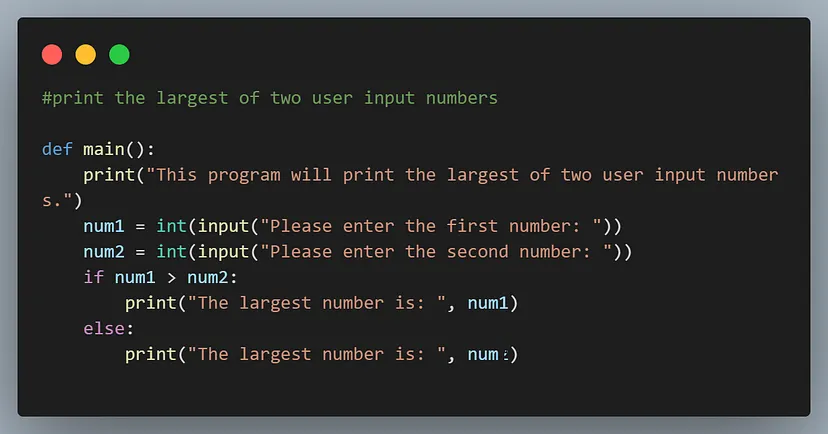
Copilot generated code to get the largest of two numbers
2. If Monday = 0, Tuesday = 1 etc. write an algorithm which:
- Asks the user to enter a number
- Outputs the day that the number represents
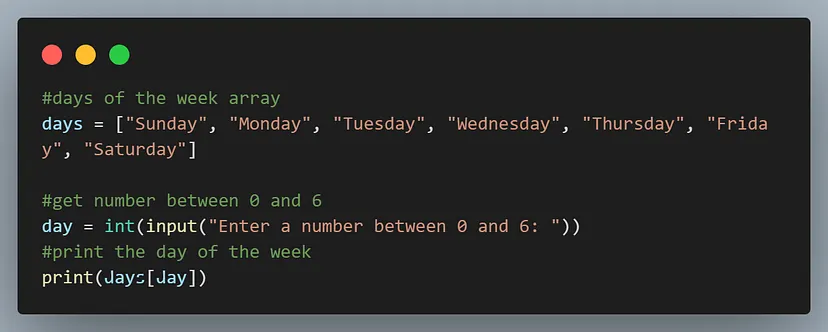
Copilot generated code to get the day of a week from an array
3. A program has been written to obtain 3 random virtual dice rolls:
DiceRoll(1) = Random Number 1–6
DiceRoll(2) = Random Number 1–6
DiceRoll(3) = Random Number 1–6
DISPLAY DiceRoll(1)
DISPLAY DiceRoll(2)
DISPLAY DiceRoll(3)
Rewrite this algorithm so that it makes use of iteration.
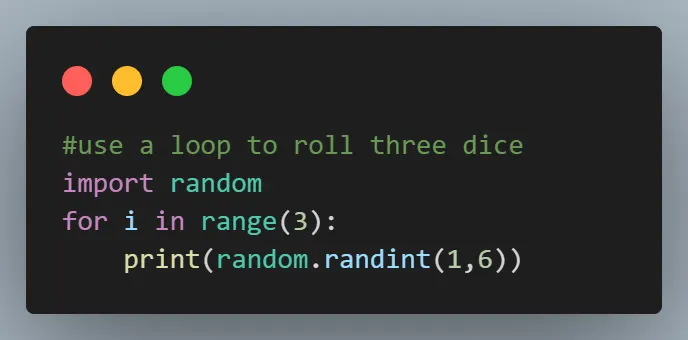
Code for three dice rolls using a simple loop
4. You need to write a program that converts the age of a dog to the equivalent age of a human.
- Asks for the age of the dog in years
- If the age is 2 or less, the human equivalent is 10.5 times the age
- If the age is more than 2, the human equivalent is 21 for the first 2 years, plus 6 for every additional year
All I wrote here was “Get dog age!” The rest was tabs and returns.
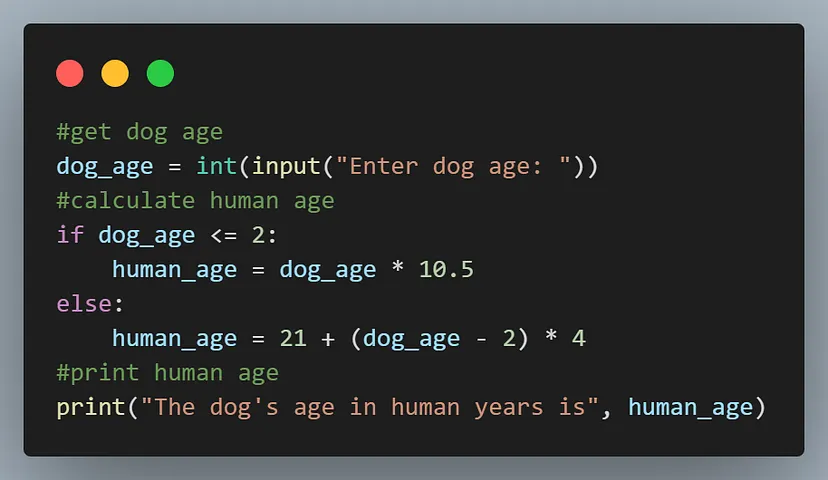
Code to get a dog’s age in human years took just three words from me
5. In a factory, the wages earned by a worker is either £2 for every teddy bear they have made or £5 for every hour they have worked, whichever is higher:
- Allows the user to input the number of teddy bears made and the number of hours worked
- Calculates the wages for the number of teddy bears made
- Calculates the wages for the number of hours worked
- Outputs the larger of the two results
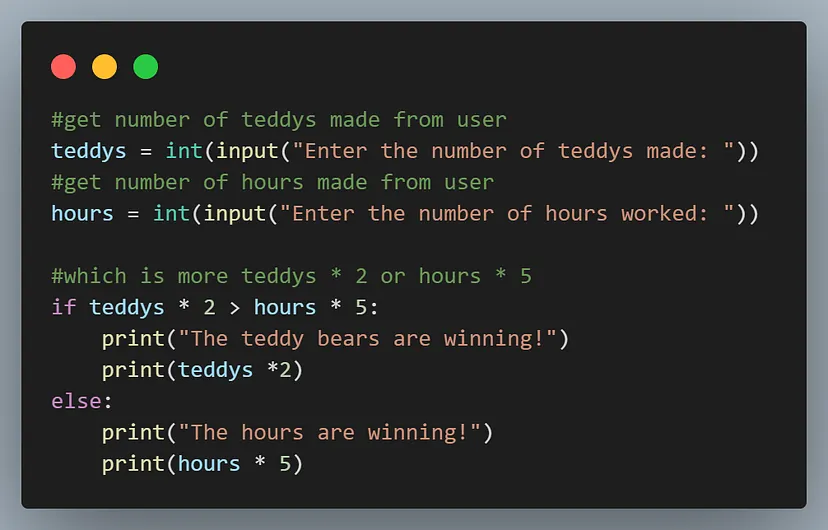
Code to calculate which approach to making bears is better
6. An isosceles triangle is one which has at least two equal length sides:
- Asks the user to enter the lengths of a triangle
- Works out if the triangle is isosceles
- Outputs a message stating whether the triangle is isosceles or not
I didn’t even manage to finish my first comment here. After the word ‘check’, Copilot knew what I wanted, bad spelling and all.
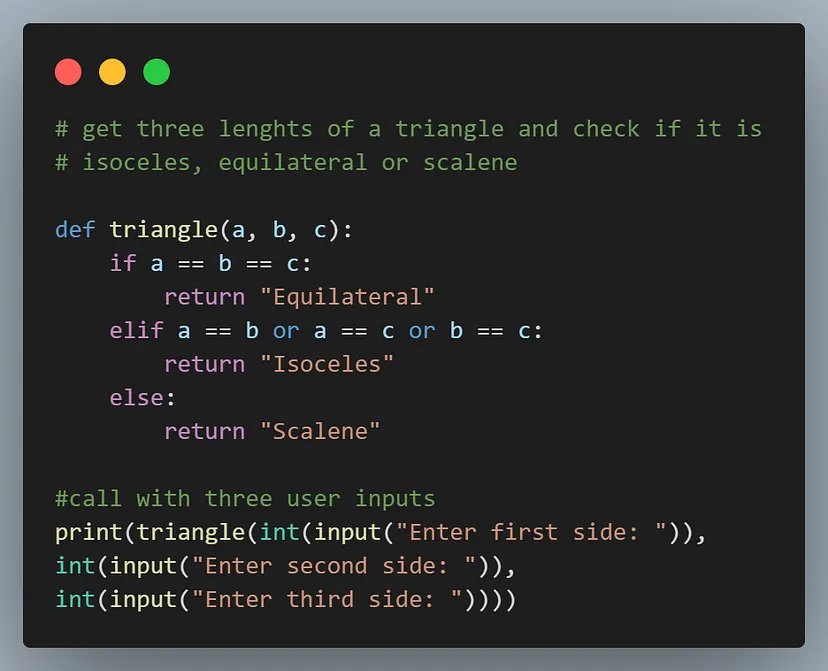
Code to return type of triangle
7. A taxi firm charges £3 for the first mile and £2 for every mile after that:
- If there are 5 or more passengers, an extra 50% is added to the price
- Ask the user to enter the number of passengers and distance
- Calculate the price of the journey and output on screen
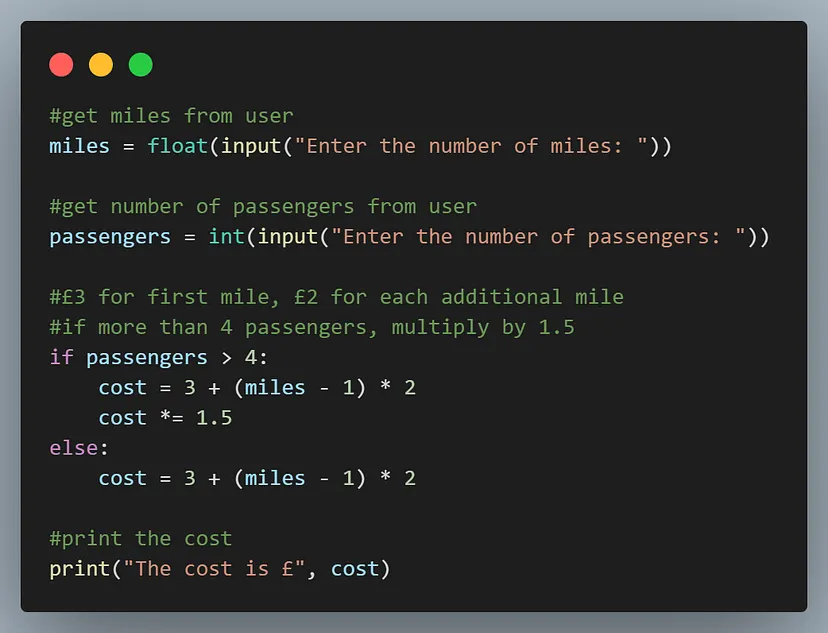
Code to interpret many conditions to calculate a taxi fare
For now, my students are unaware of Copilot and all it offers. And of course, spewing some Python without understanding a line of it is hardly learning — my students in fact had to write their solutions by hand using Pseudocode before opening any IDE.
Using Copilot, though, feels a lot more like cheating than a cheeky Google, or a copy and paste from StackOverflow. I am looking forward to seeing how it becomes adopted in the future. Will it be banned in educational settings, or embraced as just another tool?